


News

Výběrové řízení
Ředitel Geologického ústavu AV ČR, v. v. i. vyhlašuje výběrové řízení na obsazení míst vysokoškolsky vzdělaných pracovníků výzkumných útvarů v oborech:
• Geologie, strukturní geologie
• Petrologie, geochemie
• Geologie a geochemie životního prostředí
• Paleontologie
• Geofyzika
Více informací naleznete zde. Formulář pro výkaz činnosti zde.
Major appreciation of Jan Borovička: Award of the President of the Czech Academy of Sciences for science promotion
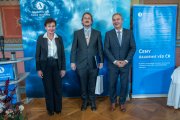
Major appreciation of Jan Borovička: Award of the President of the Czech Academy of Sciences for science promotion
RNDr. Jan Borovička, Ph.D. of the Department of Environmental Geology and Geochemistry of the Institute was granted the Award of the President of the Czech Academy of Sciences for the promotion or popularization of research, experimental development and Innovation. The Award appreciates his long-lasting effort in mediation of scientific achievements to the public, especially in the fields of mycology and study of mushrooms (macrofungi).
Jan Borovička is a scientist working for the Institute of Geology CAS and Nuclear Physics Institute CAS. His research is focused on mushrooms and the ability of their fruit-bodies to accumulate trace elements. He is engaged in mycology, taxonomy, ecology and chemical composition of mushrooms including analytical methods. His expertise thus interconnects mycological research with methods employed in geochemistry.
Besides scientific work, Dr. Borovička is involved in science promotion, regularly sharing his scientific results with the public via media and lectures. For example, he was a guest to the Lucie Výborná series in the Czech TV and Czech Radio – Radiožurnál in 2025. His interviews were also published in the Marianne magazine, in the MF DNES newspaper and on the iDNES.cz server. He published over 100 scientific columns in the Orientace Lidových novin (national newspaper).
Photo: Josef Landergott, Division of Public Outreach of the Centre of Administration and Operations of the Czech Academy of Sciences
Strategy AV21 – a workshop presenting the results of research in public interest

On 10 November 2026 from 9:45, the main building of the Institute will be hosting an annual workshop presenting the results of the study of processes in the interior of the Earth, on its surface and in its atmosphere having a direct impact on human lives and activities. These studies are conducted at several institutes of the Czech Academy of Sciences under coordination of the Strategy AV21 – Dynamic Planet Earth programme. Results of this research contribute to the assessment of effects, or even hazards, imposed on our society by natural processes.
Programme of the workshop can be accessed here
For Dynamic Planet Earth webpages, here
Open Days at the Institute of Geology of the Czech Academy of Sciences

What is the real range of research activities in geosciences? A helpful intro will be provided at the Open Days of the Institute of Geology of the Czech Academy of Sciences. We will take you on a journey across continents where our scientists work. You will learn about the field campaign, field sampling, and the analyses applied to the collected rock samples back in the lab.
A short introductory presentation will be followed by a tour of selected laboratories. You will have a chance to use a microscope to examine real geological specimens and get acquainted with modern instruments and methods used by the geologists to explore the processes on our planet – both past and present. The leading research topics to share include the study of fossils, minerals, and rocks, as well as many current problems like contamination of the environment, natural hazards, and the dispersal of volcanic ash.
Indeed, geology is not just a boring science about “stones”. It helps in the understanding of serious issues: the evolution of life, climate change, and current natural processes. Many of them are crucial to modern society – from the utilization of mineral resources to the prediction of natural hazards.
The Open Days will be held on 4 and 5 November 2026, from 9 AM to 4:30 PM, at the Institute of Geology of the Czech Academy of Sciences in Praha-Lysolaje. Additional information can be found here
Jiří Bek has been elected 'Director at Large' of the International Commission on Paleozoic Microflora

Jiří Bek has been elected 'Director at Large' of the International Commission on Paleozoic Microflora (CIMP). Founded in 1958, the CIMP is an international organisation of palynologists who study organic microfossils-palynomorphs, from the Paleozoic era, such as spores, pollen grains, acritarchs, chitinozoa, dinoflagellates, and scolecodonts. The CIMP's main focus is determining the age of sediments and the types of paleoenvironments. The organisation creates standards and rules for describing fossil palynomorphs, co-defines the age of stratotypes, and correlates important layers of Paleozoic sediments (oil and mineral deposits) worldwide. The organisation also holds conferences, symposia, workshops and excursions, and awards student grants.
New monograph on the geology of the České středohoří Mountains
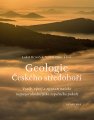
A new monograph, Geology of the České středohoří Mountains, has been published by ACADEMIA. The book offers a comprehensive insight into one of the most distinctive geological regions of the Czech Republic. It explores the České středohoří Mountains from geological, volcanological, tectonic, paleontological, mineralogical, and economic-geological perspectives. The scholarly content is complemented by extensive photographic documentation, visual reconstructions of ancient landscapes, and accessible texts aimed also at the general public.
A team of experts from the Institute of Geology of the Czech Academy of Sciences made a significant contribution to the preparation of the book.
More information about the book here:
Science outreach in geology and paleontology for grammar school students
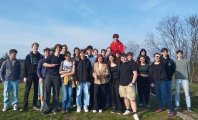
From February to April, students of the Geographical Grammar School (Pod Táborem, Prague 9) took part in a series of geological and paleontological activities focused on the history of life and geology of Prague. The educational programme was held within Strategy AV21, the Dynamic Planet Earth programme, and was led by Martina Kočová Veselská of the Institute of Geology of the Czech Academy of Sciences. Its paleontological part took place in the exhibitions of the National Museum, where students learned about the history of life. This was followed by two geological field excursions to the Divoká Šárka Nature Reserve. During the fieldwork, students identified and examined characteristic rocks of the area and learned about stratigraphy, geology and settlement history of this important site.
Paleontological conference

The Institute of Geology of the Czech Academy of Sciences is organizing the 25th Czech–Slovak–Polish Paleontological Conference & MIKRO 2026, which will be held at Villa Lanna in Prague on October 22–23, 2026. Details here.
This international conference focuses on current topics and the latest research in paleozoology, paleobotany, and micropaleontology. The program will also include several workshops and field excursions.
Additional information is available from the conference website here
We look forward to welcoming you.
On behalf of the organizing team, Jana Votočková Frojdová
Several new awards granted to Václav Cílek
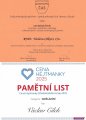
In late March, Václav Cílek was granted the Eduard Štorch Award by the Czech Archaeological Society for his promotion activities in archaeology. This award follows multiple collaboration with archaeologists, resulting in the publication of a trilogy on historic trails, books on Říp Hill, Blaník Hill, the Vltava River and on other locations. Václav Cílek also received the Award of the Governor of the Central Bohemian Region in the “Education” category for a series of 12 books on this region. Two of the volumes were edited by the former staff member of the Institute of Geology Karel Žák (Křivoklátsko and Džbán). Besides, a special award of the Governor was granted to ing. Josef Velfl, who founded the Open-air Mining Museum near Příbram and who collaborated with Václav Cílek on the book “Uranová Příbram” (Dokořán Publishing House, 2022, re-edition 2026). Congratulations.
Award for Anna Žigová
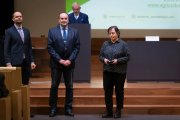
Anna Žigová of the Institute of Geology was awarded a silver medal by the Czech Academy of Agricultural Sciences at its plenary session on 3 March 2026, honouring her outstanding contribution to the development of science and research in the field of agriculture. A. Žigová is professionally engaged in pedology, especially the genesis and classification of soils in the Czech Republic. Additional information on the award and the event can be found here:
News archive
Looking for older news? Visit the news archive (news older than one year).